
Try This
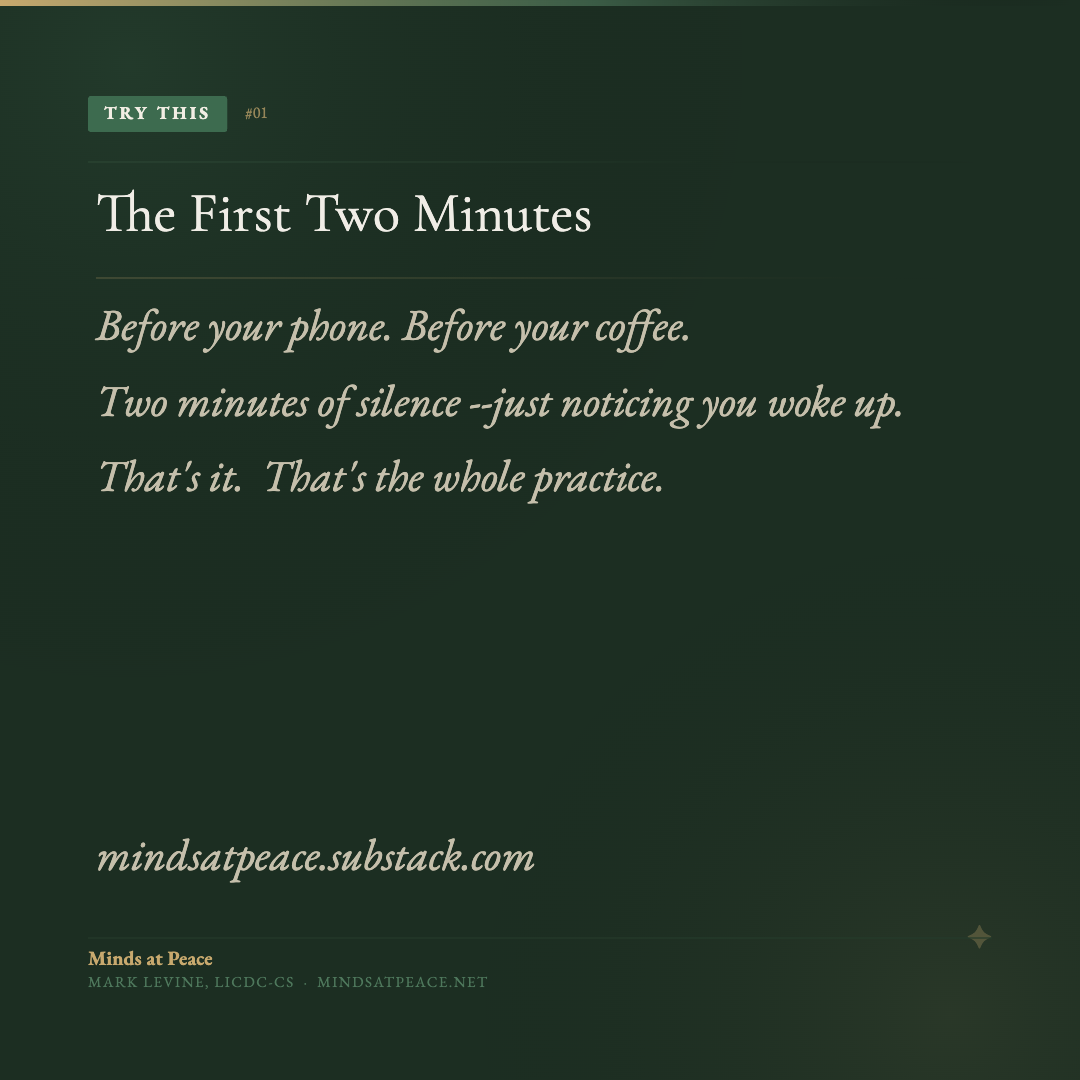
Issue 01: The First Two Minutes
It sounds almost insultingly small. Two minutes. What could that possibly do?
Here's what it actually does: it establishes, at the start of the day, that you
are the one setting the terms — not the notifications, not the algorithm,
not the first urgent thing that arrives in your inbox.
Two minutes of silence is a declaration of direction.
It is also, in the language I use with my clients, a small act of discovery:
a moment of genuinely meeting yourself before the day tells you who to be.
Try it tomorrow. See what happens to the hour after.
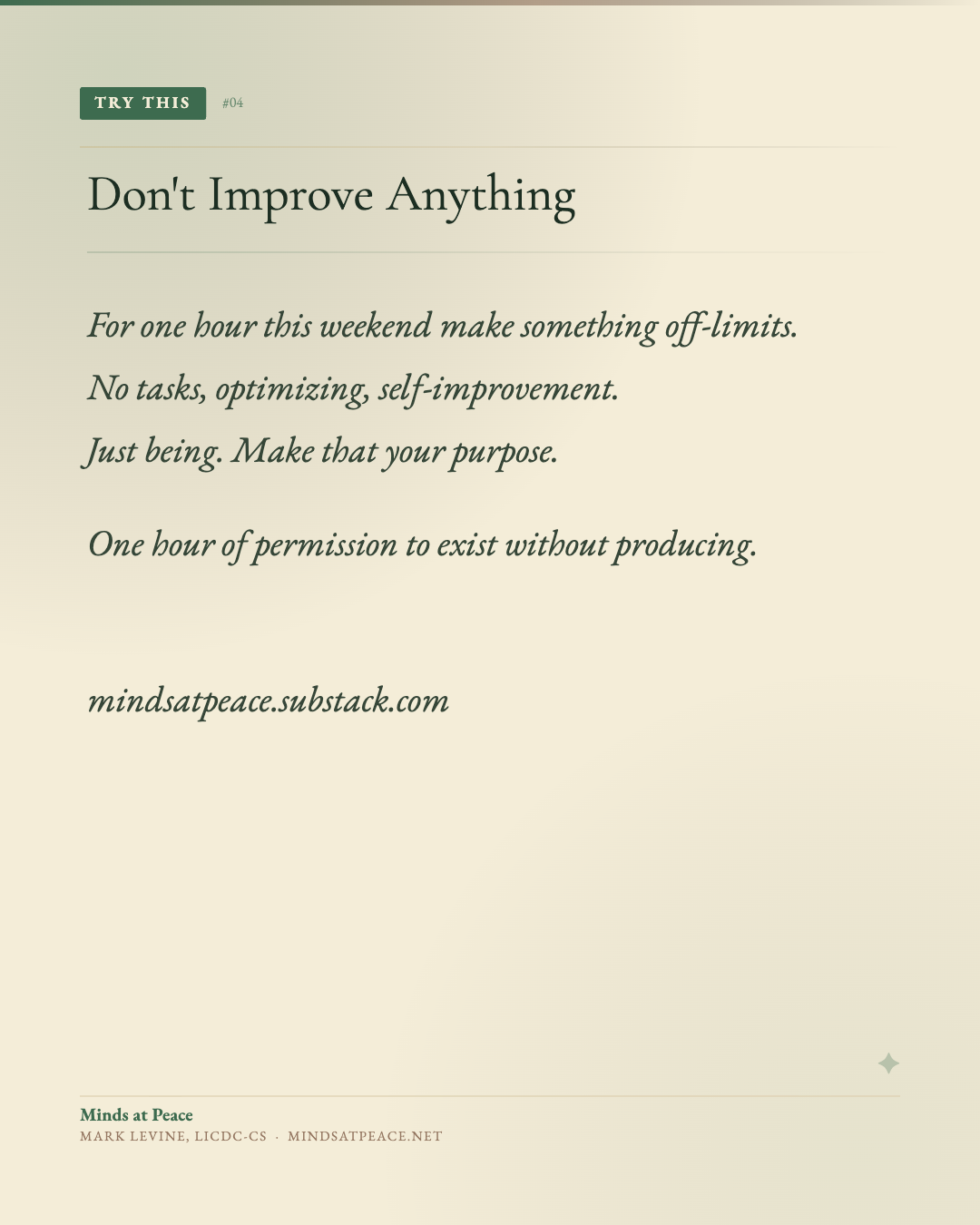
Issue 04: Don’t Improve Anything
Shabbat — the Jewish day of rest — is one of the oldest
and most radical ideas in human civilization:
the command to stop.
Not because the work is finished.
Because stopping is holy.
This is not laziness. It is the opposite of laziness.
It takes enormous discipline to put down the list
and simply be present in your own life for one hour.
It is also, in my clinical experience,
one of the most important things a person in discovery can practice.
Because the addictive pattern almost always includes
an inability to be at rest —
a need to manage, to produce, to fill the silence.
One hour of holy stopping is, among other things,
practice in tolerating stillness.
Pick the hour. Protect it.
See what you find inside it.
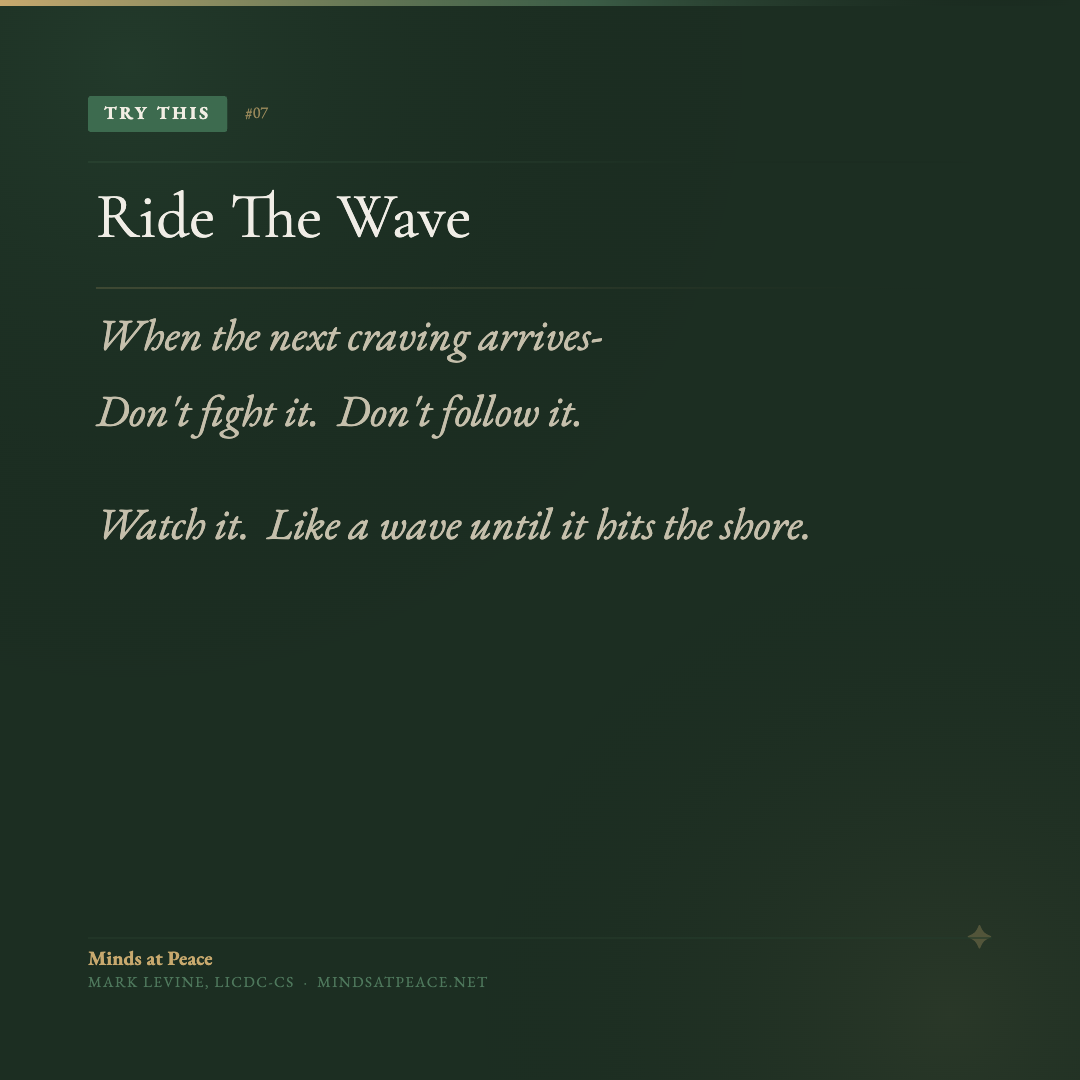
Issue 07: Ride The Wave
Urge surfing is one of the most well-researched tools
in relapse prevention — developed by the late G. Alan Marlatt,
one of the foundational researchers in addiction psychology.
The insight is simple and counterintuitive:
urges are not permanent states requiring immediate relief.
They are temporary, like waves.
They build, peak, and pass.
The problem is that we almost never let them pass,
so we never learn that they do.
Every time we act on an urge the moment it arrives,
we confirm the belief that the urge is unbearable.
Every time we watch it and wait —
even once, even imperfectly —
we discover something more accurate:
it passes.
The wave breaks. It always does.
Today: when the next urge arrives —
for anything, not just the big things —
set a timer. Watch it. Don't fight it. Don't follow it.
Just observe.
Issue 10: What You Carry
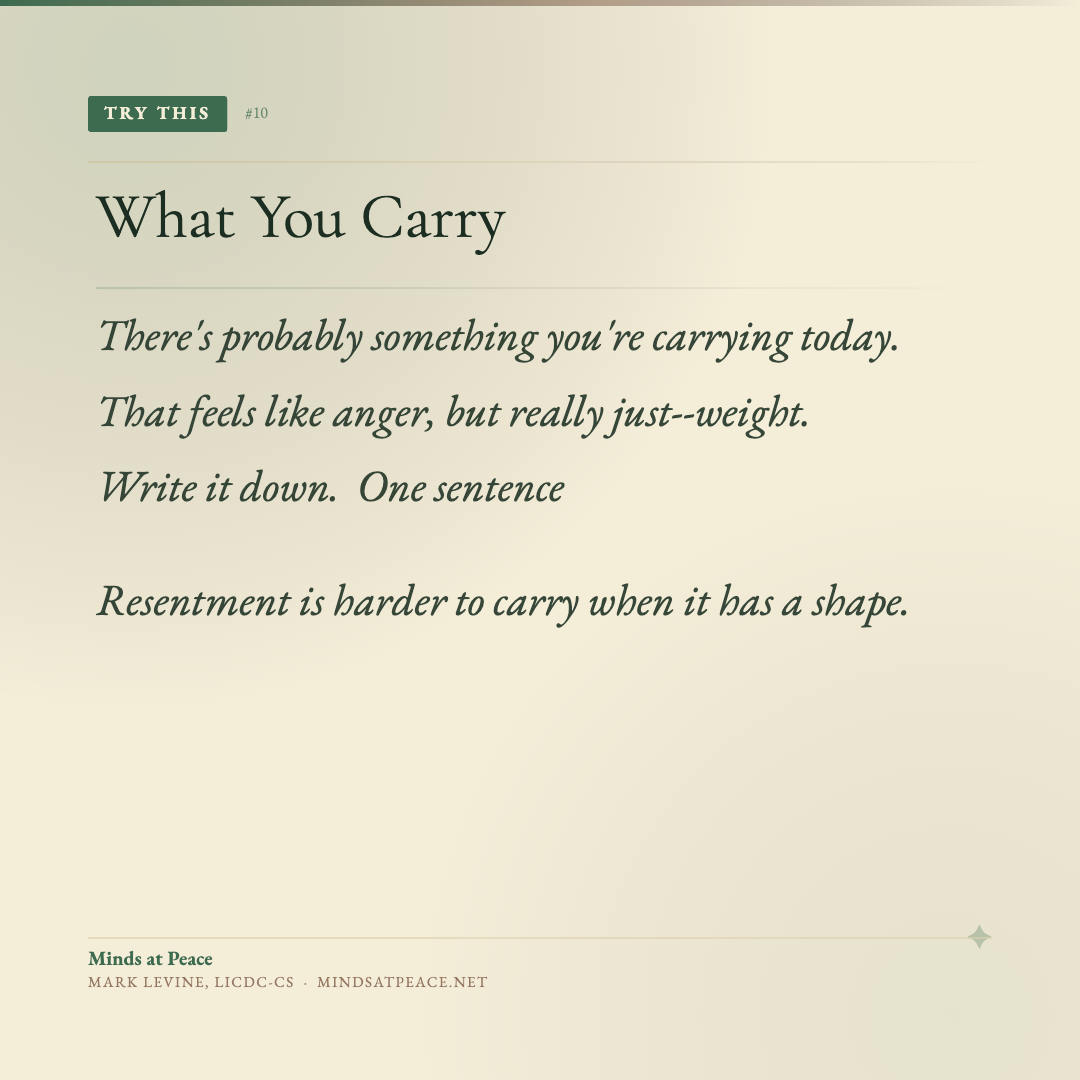
There's probably something you're carrying today
that feels like anger at someone else
but is really just — weight.
Write it down in one sentence. Not to send.
Just to see it outside your head.
Resentment is harder to carry when it has a shape.
---
The Talmud in Yoma 9b makes a claim that stops me every time I read it:
The Second Temple was destroyed because of baseless hatred.
Sinat chinam — unearned grievance, accumulated resentment.
The rabbis are saying that the greatest catastrophe
in Jewish history was caused not by military failure,
not by theological error —
but by unaddressed interpersonal resentment,
held and cultivated over time.
They took this voice seriously as a force capable of destroying
not just individuals but communities.
I do too.
Resentment is one of the most consistent relapse triggers
in addiction research. It's also one of the most underestimated —
because it doesn't feel like a craving.
It feels like justice.
As you go into Shabbat today:
what weight are you carrying?
Put it on paper. Give it a shape.
Then set it down for 25 hours.
It will still be there if you decide to pick it up again on Saturday night.

Issue 02: A Better Question to Start the Day
The shift from "have to" to "get to" is not toxic positivity.
It is not pretending the hard things aren't hard.
It is a very small act of what psychologists call cognitive reframing —
and what the Jewish tradition calls teshuvah:
not changing the facts, but changing the direction you are facing them from.
The day is the same. The question changes what you bring to it.
One question. Try it this morning

Issue 05: Name The Voice Before It Names You
The next time a familiar destructive thought arrives,
don't argue with it. Just name it.
"That's the Voice of Permission."
"That's Despair talking."
"That's the Voice of Escape."
You can't fight what you can't see.
Name it first. Then decide.
The Talmud says something about the yetzer hara —
the inner adversary — that I think about constantly:
"It does not come to you and say: go and sin.
It says: do this small thing."
It is patient. It is persuasive.
It speaks in your own voice.
Which is exactly why naming it matters so much.
The moment you give it a label — "oh, that's the Voice of Permission" —
you create a small but real distance between you and it.
And distance creates choice.
This week I'm introducing something I call the Ten Voices —
a framework for understanding the specific ways
the destructive impulse operates in different people.
Today: just start with the practice.
The next thought that pulls you somewhere you don't want to go —
name it. Don't argue. Just name it.
More on the voices throughout the week.
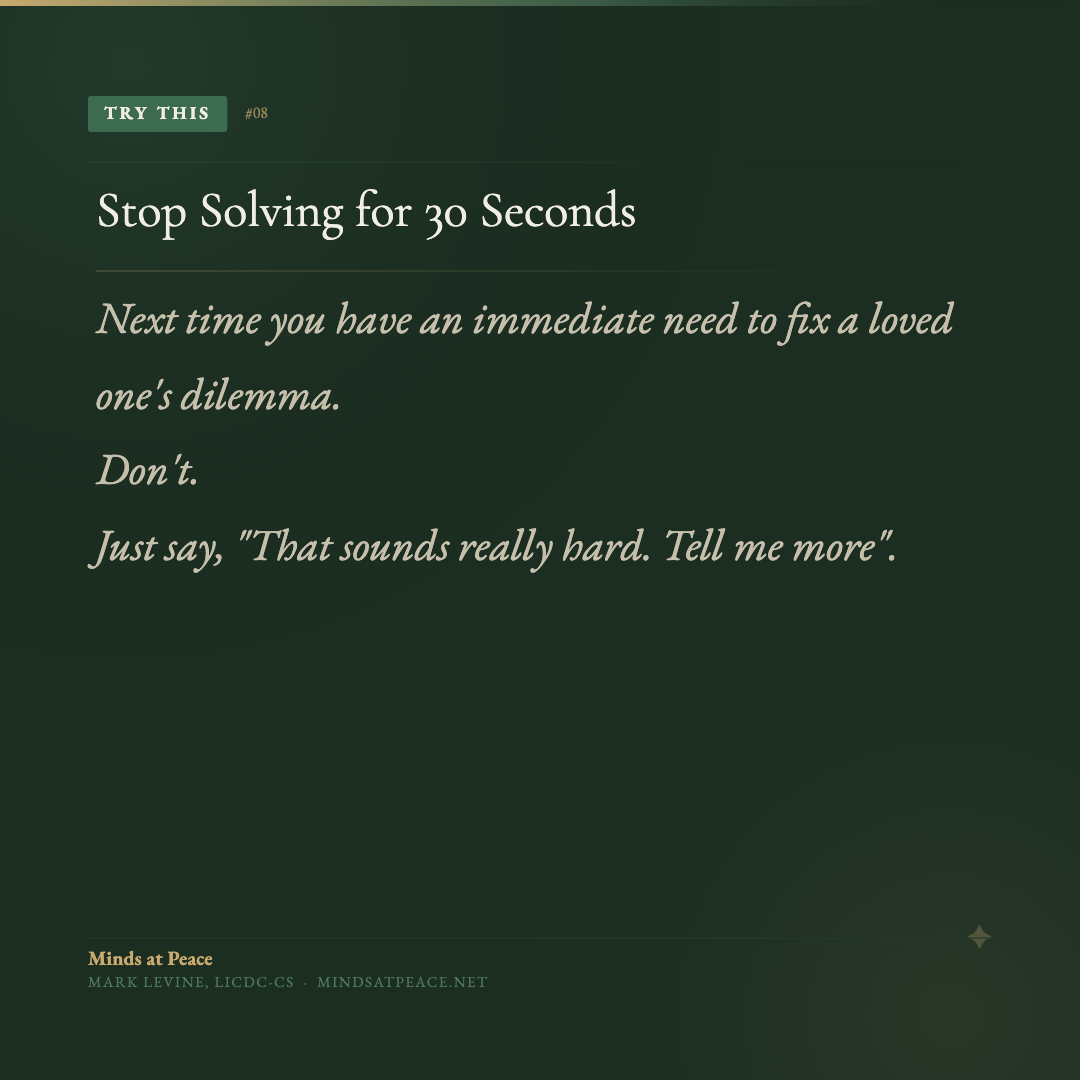
Issue 08: Stop Solving For 30 Seconds
This one is for the family members —
the spouses, parents, adult children, siblings —
who are living alongside someone else's struggle.
Here is something I have watched happen hundreds of times:
A person shares something vulnerable.
The person who loves them immediately goes into solution mode.
And the vulnerable person closes.
Not because the solution was wrong.
Because the move to solution —
however loving, however smart —
communicates: your feeling is a problem I need to fix.
"That sounds really hard. Tell me more."
Four words and four more.
It communicates something entirely different:
your feeling is worth staying in for a moment.
I am not trying to make it go away.
I can be here with you inside it.
That is often the only thing the person needed.
Try it once today.
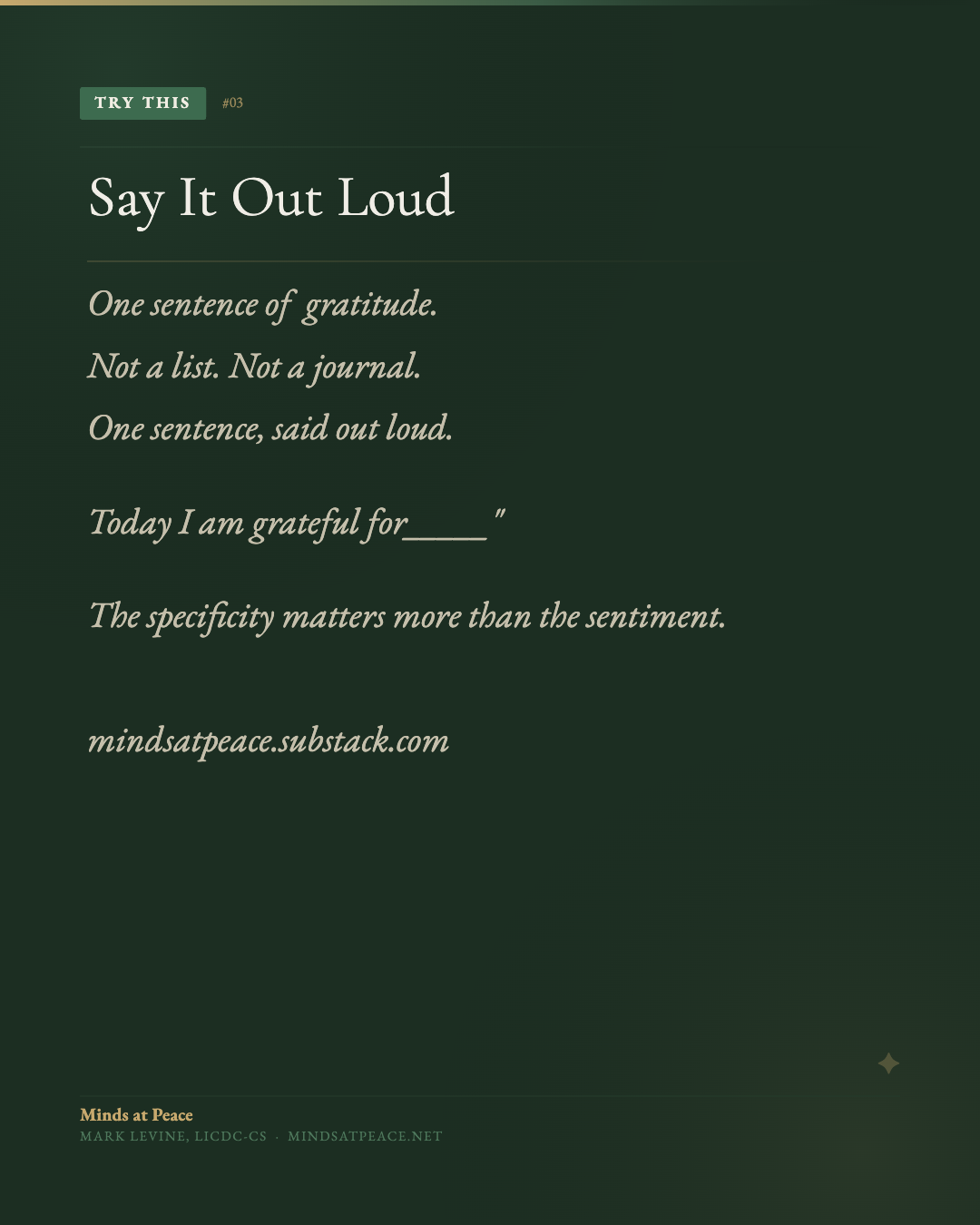
Issue 03: One Sentence of Gratitude- Out Loud
There is a meaningful difference between thinking a grateful thought
and saying it out loud.
When you say it — even alone, even to no one — it becomes real
in a different way. The body hears it. Something shifts.
The research on gratitude practices is solid and not surprising:
regular, specific gratitude expression reduces anxiety, improves sleep,
and — for people in recovery — is one of the most reliable
predictors of sustained progress.
The tradition knew this too.
Jewish morning prayers begin with Modeh Ani — "I give thanks" —
before you have done anything, achieved anything,
or figured out what kind of day it's going to be.
Gratitude first. Then the day.
Try it tomorrow before you walk out the door.
One sentence. Specific. Out loud.

Issue 06: HALT Before You Act on Anything
HALT is one of the oldest tools in recovery - or what I call discovery work,
and it keeps getting rediscovered by researchers
because it keeps being true.
The neuroscience is straightforward:
when we are hungry, angry, lonely, or tired,
the prefrontal cortex — the part of the brain
responsible for judgment and long-term thinking —
is the first thing to go offline.
And the voices fill the space it leaves.
The Voice of Permission sounds most reasonable when you're exhausted.
The Voice of Despair is loudest at 2am.
The Voice of Escape intensifies under stress.
HALT doesn't solve these things.
But it names the condition — and naming the condition
is the first step toward not acting on it automatically.
Today: before any decision that matters, check in.
Four questions. Thirty seconds.

Issue 09: The Thing You’ve Not Been Saying
The Book of Proverbs — says:
"Death and life are in the power of the tongue."
I've spent a lot of time thinking about the death side of that verse.
The damage words can do.
But the life side is worth equal attention.
The words we withhold — the appreciation not expressed,
the apology kept in our heads, the "I love you" we assume is understood —
carry their own cost. A quiet one. Accumulated over time.
The research on expressed gratitude, on genuine acknowledgment,
on the simple act of saying something true and kind —
it is consistent and not small.
People who receive specific, genuine appreciation
from someone they care about report
lower anxiety, stronger sense of connection,
and — for people in recovery — measurably better outcomes.
The unsaid thing has weight.
Say the thing.
Not perfectly. Just actually, today.